


Company Profile PDF
As the business environment grows increasingly complex, delivering management messages to stakeholders in a way that not only “communicates” but also ‘resonates’ has become a key factor in enhancing corporate value. Amid this shift, a new visual communication technique called the “statement movie” is gaining significant attention.
On November 26, 2025, an online seminar titled “Differentiating Stakeholder Communication Strategies to ‘Resonate’ with Investors, Employees, and Candidates,” co-hosted by TYO Inc. and Brand Journalism Inc., shared concrete case studies and practical know-how on the potential of this new video application.
We present the essence of this seminar, which recorded high satisfaction in participant surveys.
For detailed seminar reports and seminar viewing, please see below.
Download the seminar report here
Watching the seminar video here
A statement movie is a visual representation of a company’s vision for the future, grounded in its current state and societal challenges. It aims to visualize corporate philosophy, purpose, and management messages, fostering empathy and resonance among stakeholders such as employees, job candidates, shareholders, and investors.
Typical lengths range from one and a half to four minutes. This duration serves a purpose: it holds enough information and narrative depth that cannot be conveyed in 15- or 30-second brand videos, while staying within the range where viewers’ attention spans hold, thereby eliciting deep empathy.
Yuki Ogawa from TYO’s Business Development Division, who presented as the head of the Statement Movie division, emphasized that a key characteristic of Statement Movies is that they “contain information that delves into concrete commitments and actions for the future vision, possessing both emotional and logical aspects.”
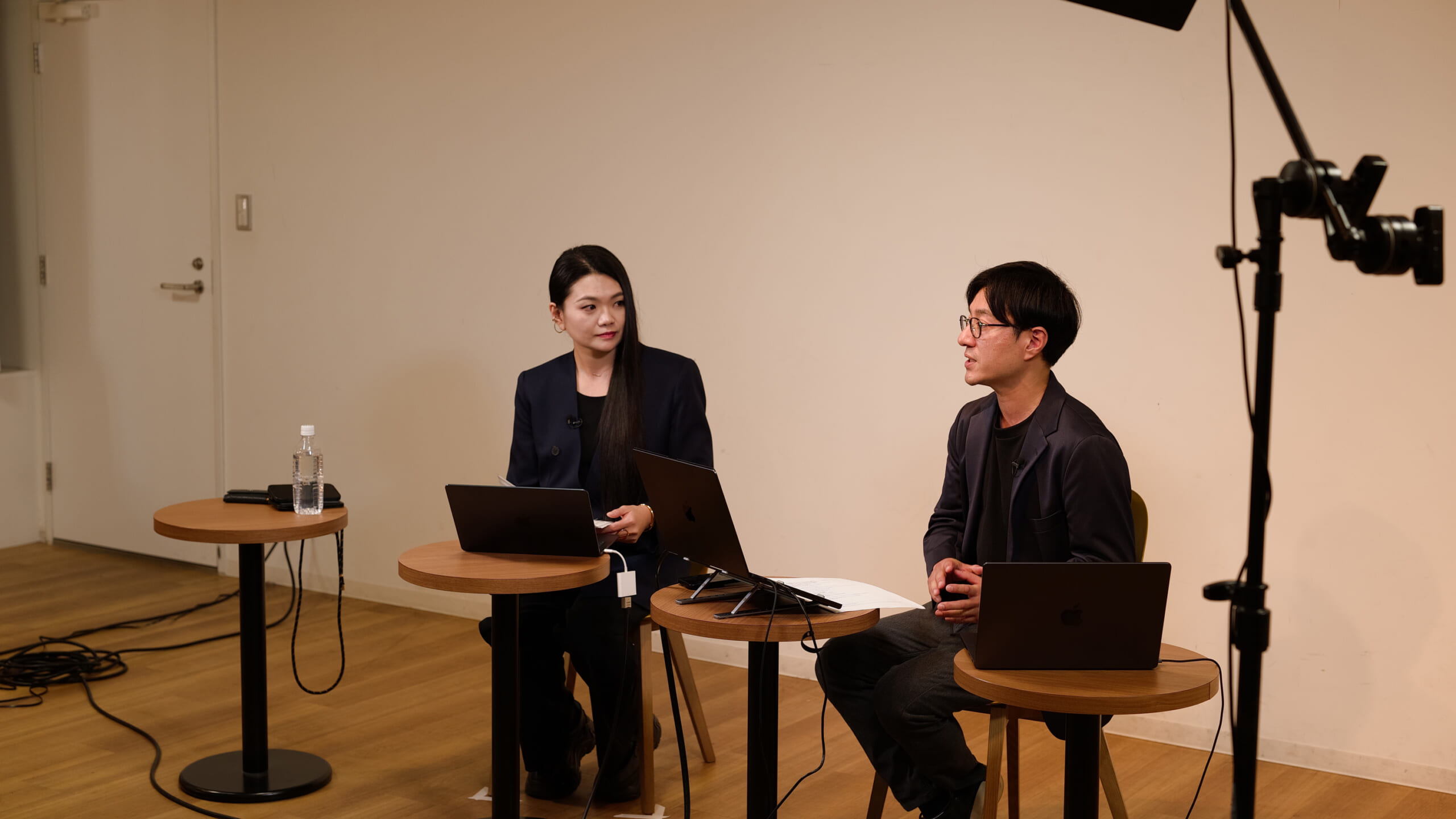
Aki Hayashi, representative of Brand Journalism, pointed out the “communication gap” as a key challenge revealed through numerous interviews with corporate leaders. There are frequent cases where a gap exists between the intentions of executives and the messages that actually reach their audience.
Amid increasingly complex management challenges—such as difficulties retaining talent, declining employee engagement, and the obsolescence of existing business models—it has become difficult to gain the empathy of employees and stakeholders through theoretical explanations alone.
For example, during one company’s earnings announcement, despite the loss being strategic, the mere term “loss” spread rapidly, burying the intended message about reform. To overcome such communication breakdowns, there is a growing need for communication that resonates with all stakeholders, incorporating emotional and sensory elements.
In recent years, the use of video in financial results briefings and shareholder meetings has rapidly advanced and is becoming the new standard.
Recognizing the challenge that “the use of video in stakeholder communication has not yet become widespread or deeply ingrained” (Ogawa), TYO is strengthening its efforts to leverage the creative power cultivated over more than 40 years in advertising video production for corporate management communication.
Indeed, inquiries to TYO show a sharp increase in consultations from corporate departments (such as corporate planning, IR, and PR), with many expressing, “We want to use video, but we don’t know where to start.”
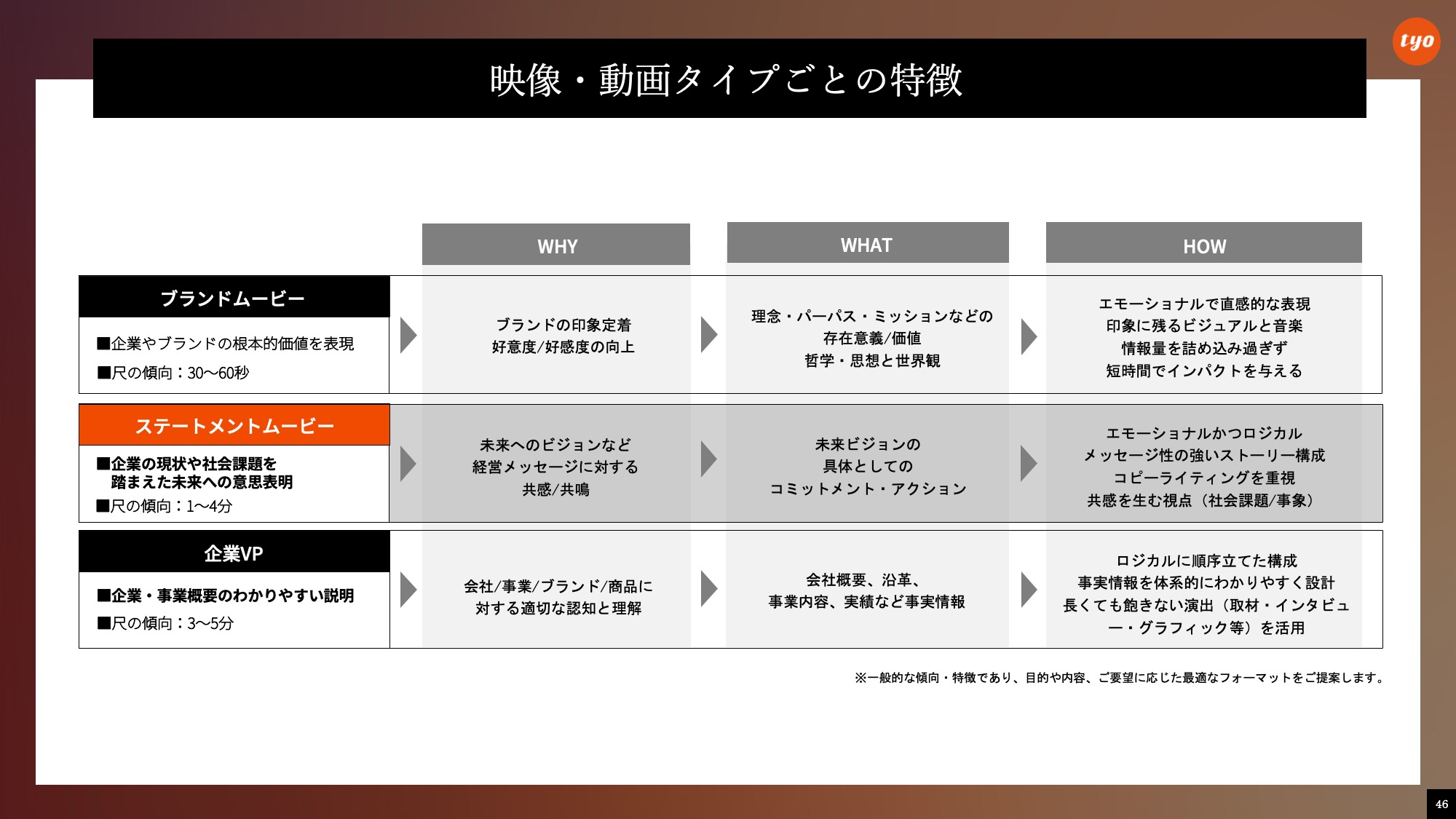
During the seminar, Ogawa provided a clear breakdown of the “types” of video content that many companies often confuse.
✔︎ Corporate VP (Video Package, company introduction video): Logically explains factual information such as the company’s business, history, and sales. Primarily targets the left-brain processes of awareness, understanding, and conviction.
✔︎ Brand Movies are short-form videos, typically 15 to 60 seconds long, that intuitively express a brand’s worldview and core values. They emphasize visual impact and background music, making them particularly effective at triggering initial appeal and empathy—a right-brain process.
✔︎ Statement videos occupy a middle ground, combining the strengths of both. Their length—typically 1.5 to 4 minutes—allows for greater information density and facilitates storytelling. This enables them to cover a broader spectrum, from promoting understanding to fostering empathy and resonance.
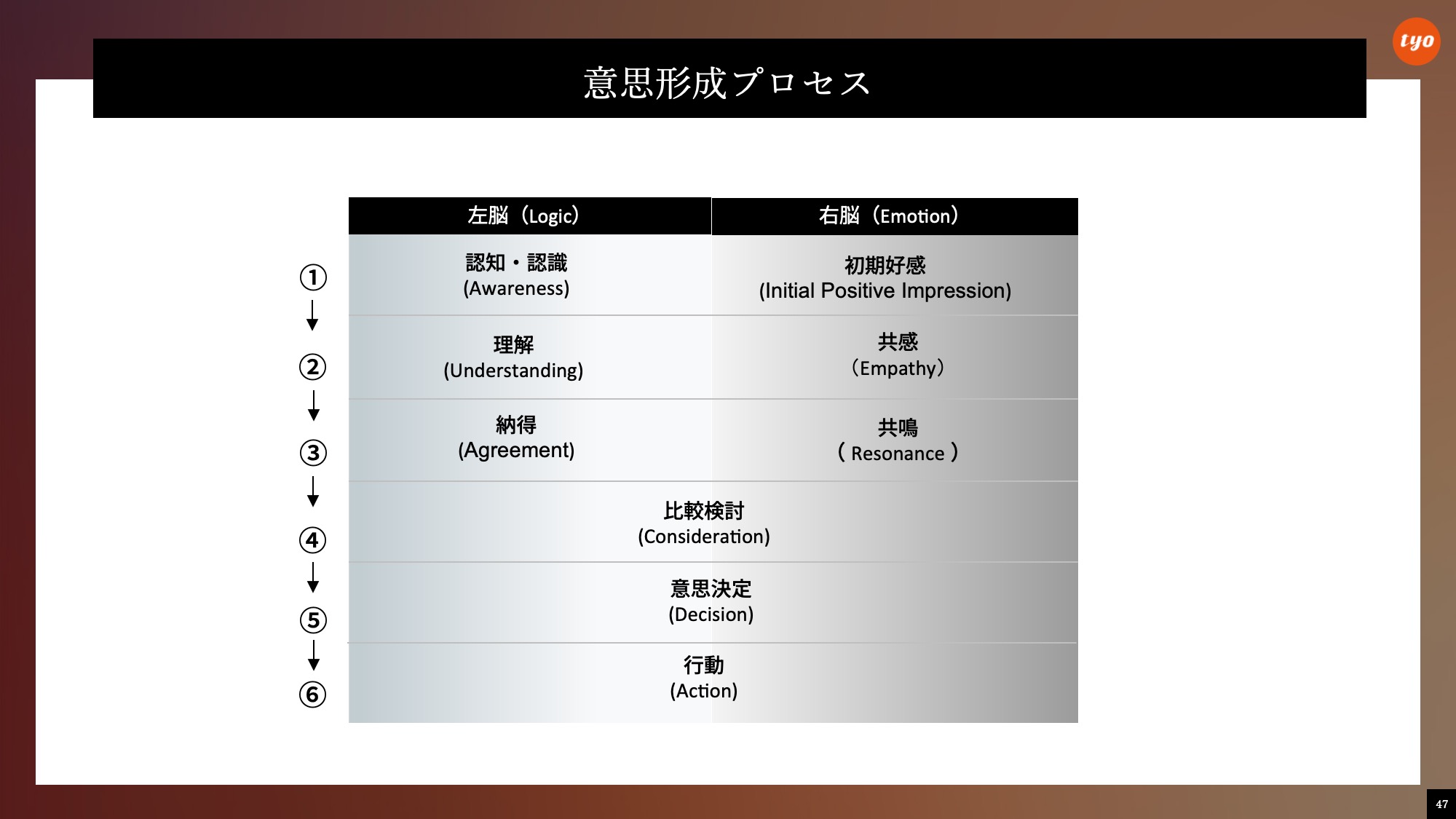
Particularly noteworthy at the seminar was TYO’s Ogawa’s unique framework, which divides the decision-making process into left-brain (logical) and right-brain (emotional) components.
The left-brain process follows a sequence similar to the marketing funnel: recognition → understanding → acceptance → comparison → motivation → action. Meanwhile, the right-brain process involves parallel emotional stages: initial appeal → empathy → resonance.
The strength of statement movies lies in their ability to simultaneously address both processes. By promoting understanding through logical information delivery while appealing to emotions via storytelling and visual expression, they can generate deeper empathy and resonance.
Mr. Hayashi also emphasized the necessity of this dual-pronged approach, stating, “For a leader’s vision to truly resonate with employees and stakeholders, theoretical arguments alone are insufficient; emotional and sensory elements are critically important.”
At the seminar, Iwaki FC’s statement video was introduced as a TYO case study.
TYO has partnered with Iwaki FC for over six years since 2019, consistently producing one video per year. The club’s raison d’être rooted in the Great East Japan Earthquake, its commitment to the community, and its vision for the future are expressed through annually evolving creative concepts while maintaining a consistent core.
The videos target soccer fans in Iwaki City and Fukushima Prefecture, as well as the broader local community, and are utilized on the club’s official social media and stadium screens. This approach has yielded concrete results: high praise from J.League officials, increased social media engagement, direct messages of support for players, and a rise in sponsors attracted by the videos.
Ogawa emphasized that “it’s not a one-time effort; we continue creating every year, incorporating creative ingenuity and variation while ensuring the core message remains consistent across all videos.” This continuity is the key to continually capturing the hearts of stakeholders.
Statement videos have diverse applications. At the seminar, Ogawa introduced four primary usage patterns:
In the integration domain, it proves effective for post-merger integration (PMI) and fostering a shared culture. When integrating organizations with differing corporate cultures, presenting a common vision through video can accelerate the development of a sense of unity.
In IR, their use is expanding in earnings briefings, shareholder meetings, and investor communications. By visualizing corporate value and future vision—aspects not conveyed by numbers and data alone—they deepen investor understanding and empathy.
In the internal domain, they are effective for embedding vision and purpose among employees and driving organizational transformation. It is crucial to identify the core message that truly needs to be conveyed and design it as an emotionally resonant expression, enabling each employee to personally connect with the future envisioned by leadership.
In the recruitment domain, they are used for recruitment branding, communicating messages to candidates, and strengthening closing capabilities. Particularly against the backdrop of intensifying competition in the recruitment market, there has been a surge in inquiries about leveraging video to attract top talent.
Creating a statement movie differs from general video production; it is also a process of deeply reexamining or redefining a company’s purpose and vision.
The production roadmap is broadly divided into four steps:
① Strategic Design for Stakeholder Communication
② Reorganization and Reconstruction of Mission, Vision, and Values
③ Development of the Statement
④ Production of the Statement Movie and Utilization Design
Ogawa emphasized, “It’s not just about creating it and being done. The design for when and through which channels to utilize it must be organized even before the creation phase begins.”

Furthermore, it is crucial to consider not just the video itself, but its integration with internal communications, external communications, and existing initiatives. Similar to IMC (Integrated Marketing Communications) in the marketing domain, stakeholder communications must also be designed holistically.
Through this collaboration, TYO’s video production capabilities will merge with the journalistic approach of brand journalism.
Mr. Hayashi stated, “The fundamental principle of journalism is to thoroughly engage with the reader—that is, the person receiving the message,” emphasizing the importance of a perspective that connects corporate messages with society. Journalistic expertise—including thorough pre-production research, deep understanding of companies/industries/organizations, a news value perspective, and calendar journalism (aligning with social anniversaries)—contributes to creating more impactful video content.
Hayashi emphasized that the ability to draw out executives’ true thoughts and commitment is essential for visualizing core values, rather than superficial messages.
Participants raised questions about the difficulty of measuring the effectiveness of video content.
Ogawa acknowledged, “Unlike advertising videos, it is indeed difficult to measure the quantitative effects of statement movies.” However, he presented several specific approaches: tracking changes over time in employees’ understanding and resonance with the mission, vision, and values through employee surveys; obtaining some quantitative data by also utilizing the videos for external marketing purposes; and expanding viewing opportunities in communication settings like events and pitches to capture complex effects, including reactions that digital alone cannot fully capture.
Hayashi pointed out, “We should look at the fundamental impact on management, such as reduced turnover rates, improved engagement, and the creation of new businesses,” emphasizing the importance of evaluation from a long-term perspective focused on solving management challenges, not just short-term metrics.
Statement movies are a new form of visual communication that transforms corporate messages from mere “delivery” to genuine “connection.” By engaging stakeholders on both logical and emotional levels, they foster deep empathy and resonance, contributing to the resolution of management challenges.
As their use expands across diverse scenarios—IR, recruitment, internal communication, organizational transformation—the fusion of specialized video production expertise and journalistic insight enables the creation of more essential, truly resonant content.
With the corporate environment growing increasingly complex and stakeholder communication becoming ever more critical, make statement movies your new management weapon.
For detailed seminar reports and to view the seminar, please see below.
Download the seminar report here
Watching the seminar video here

第7回 TYO学生ムービーアワード
12月16日までエントリー受付中!

